

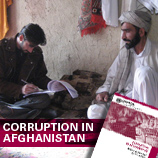
Poverty and violence are usually portrayed as the biggest challenges confronting Afghanistan. But ask the Afghans themselves, and you get a different answer: corruption is their biggest worry. A new UNODC survey reveals that an overwhelming 59 per cent of Afghans view public dishonesty as a bigger concern than insecurity (54 per cent) and unemployment (52 per cent).
Corruption in Afghanistan: Bribery as Reported by Victims is based on interviews with 7,600 people in 12 provincial capitals and more than 1,600 villages around Afghanistan. It records the real experiences (rather than just perceptions) of urban as well as rural residents, men and women, between autumn 2008 and autumn 2009.
In 2009, Afghan citizens had to pay approximately US$ 2,490 million in bribes, which is equivalent to 23 per cent of the country’s gross domestic product (GDP), according to the report. By coincidence, this is similar to the revenue accrued by the opium trade in 2009 (which UNODC estimates at US$ 2.8 billion).
Drugs and bribes are the two largest income generators in Afghanistan: together they correspond to about half the country’s (licit) GDP, said UNODC Executive Director Antonio Maria Costa as he released the report in London.
The report shows that graft is part of everyday life in Afghanistan. During the survey period, one Afghan out of two had to pay at least one kickback to a public official. In more than half the cases (56 per cent), the request for illicit payment was an explicit demand by the service provider. In three quarters of the cases, baksheesh (bribes) were paid in cash. The average bribe is US$ 160, in a country where GDP per capita is a mere US$ 425 per year.
Leave a Reply
You must be logged in to post a comment.