

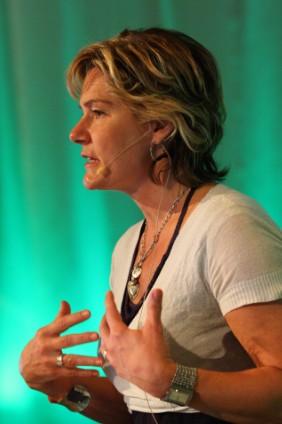
Speech by Maria Larsson, Minister for Public Health, Sweden at the 2nd World Forum Against Drugs, Stockholm 24 May 2010
Your Excellencies an distinguished guests.
I am very happy to be among those who welcome you to the Forum this year.
We meet in an era where there are several interesting things happening. In the field of health we can see a big and growing interest in how we take care of our health – How to feel better, how we can live healthier and longer. How to eat and exercise. I am of course – as minister for public health – very pleased with this broad and general interest in health issues.
On the other hand – there is a movement which likes to pave the way for increased use of narcotic drugs. We see it in several European countries, in the United States and in international cooperation.
My conclusion is that the scientific evidence of what is good for your health needs to be more widely spread.
Some say that what I choose to do as an adult is my own responsibility. But that is wrong – dead wrong. All our lives are intertwined. We interact and live together and we cooperate and act together. In fact – this is what we call a society, and the people most affected by our actions are the children.
Children have rights and needs. And it is our moral obligation to protect our children, and to see that they get as good conditions as possible. Being affected by adults using narcotic drugs – or being involved in production or trafficking of drugs – is not in accordance with good living conditions. And even less so when they use narcotic drugs themselves.
The right to your family, to education and to food – is expressed in the UN Convention on the rights of the child. Children also have a right to be protected against certain specific threats according to the convention: For example sexual exploitation, armed conflicts – and drugs.
I think we can use the Convention on the right of the child much more in this respect.
The Convention is the only UN Human Rights Convention that has explicit statement about narcotics and drugs.
Protection against drugs is therefore unquestionably a human rights issue. Protecting children from illicit use, from production and from trafficking of drugs – is not an option for States Parties, it is an obligation.
Young people have access to an increasingly wide range of substances and are sometimes using them in combination with alcohol. The majority of young people in the European Union have never used illicit drugs. But – among those who have – cannabis is the most frequently used drug. In general, the likelihood of young people being offered cannabis, or other illicit drugs, as well as their willingness to try drugs, increases sharply with age.
Evidence suggests that early experimentation with psychoactive substances is associated with an increased risk of developing drug problems later in life.
The most ineffective way to deal with narcotic drugs is to deny it. It is better to offer treatment and care. Better than that is to try to stop it and curb it. And the best way to deal with it is to prevent it.
Sweden is definitely not good enough – but in the area of prevention – I am convinced that we are on the right track. Using narcotic drugs is considered not acceptable, by professionals in medicine, by health authorities and by people in general. There is a widespread recognition that using psychoactive substances is not compatible with living a healthy, independent and moral responsible life.
There are of course several reasons why this is the case in my country: One of the most important ones being all the voluntary organizations who work in this field.
I am actually meeting representatives for the voluntary sector this afternoon to start the discussion on how to prevent drug abuse in the future.
Getting as much involvement as possible – from as big parts of the society as possible – is a cornerstone of preventive tactics.
One reason Sweden has a preventive approach is our experiences during the 1960`s.
Sweden was actually among the first countries in Western Europe to experience a large-scale drug problem among young people. Several drugs were seen as non-addicting and had widespread clinical use at the time.
Swedish physicians and authorities thought it would be a good idea to prescribe them, not only stimulants but also opiates and in huge quantities. Several million doses were given out legally, but the result was that they were spread illegally over Sweden. It came to an abrupt end after the death of a 17 year old girl who had been offered drugs by a patient in the prescription program.
Nils Bejerot, who we are honoring today, saw this at the time and managed to turn it around – with the help of others.
From experiences like this grew recognition that the use of narcotic drugs has an epidemic character. And that once you use it – the effort it takes to be able to live without it is enormous. For many it overtakes your life. And for some – it ends your life. It is like playing with a baby crocodile in your plastic pool. They say it is a nice experience in the beginning.
But when the crocodile grows bigger it will eat you, and it will chew your pool.
Preventing drug use before it begins is a cost effective, commonsense way to build safe and healthy communities. Prevention science has made great progress in recent years. Many interventions are being tested in “real-world” settings so they can be more easily adapted for community use. Scientists are studying a broader range of populations and topics. They have identified, for example, effective interventions with younger populations to help prevent risk behaviour before drug abuse occurs. Researchers are also studying older teens that are already using drugs to find ways to prevent further abuse or addiction.
During the Swedish Presidency of the European Union last fall, we also managed to increase the European Union work with prevention. The Council conclusions, which were adopted, promotes universal prevention and EU-member states also agreed to offer parental support and family management programmes.
The well-known saying proves to be right: “An ounce of prevention is worth a pound of cure.”
Looking at the present drug discussion – there are efforts undertaken to legalize narcotic drugs; primarily marijuana. Pro-drug messages of different kinds are being spread worldwide. This promotion is aimed directly at young persons.
Efforts are also being made to play down the risks associated with drug abuse and above all to portray cannabis and some of the synthetic drugs as safe and harmless.
It is evident that we need to work effectively to build a political consensus to create broad public support for a comprehensive and restrictive drug policy based on the UN Conventions.
We need to reduce both the supply side and the demand side of narcotics. We need to focus more specifically on prevention, treatment and control – three equally strong pillars.
And we need to keep our vision of a drug-free society.
Illicit drugs must continue to be … illicit. The respect for human dignity and the protection of children demands this. And at the same time we must tackle the negative social and health consequences of narcotic drug use.
This can be done together. And looking at all of you I am convinced it is a struggle we will win. Welcome and I hope for a successful forum.
Thank You.
Leave a Reply
You must be logged in to post a comment.