

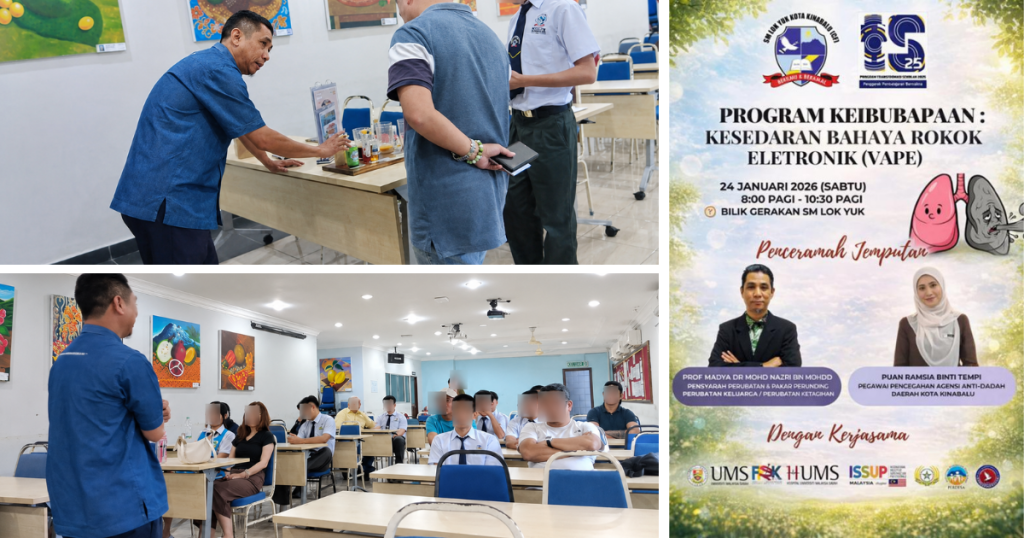
The following text was kindly shared with WFAD by Dr. Mohd Nazri Bin Mohd Daud, highlighting a recent Parental Engagement Initiative on Adolescent Vaping Prevention held in Kota Kinabalu, Sabah, Malaysia. The programme focused on strengthening parental awareness, early intervention, and multi-agency collaboration in addressing adolescent vaping and synthetic substance use.
Parental Engagement Initiative on Adolescent Vaping Prevention was conducted in Kota Kinabalu, Sabah, Malaysia on 24 January 2026. The programme was led by the Guidance and Counselling Unit of Lok Yuk Secondary School in collaboration with the Parent–Teacher Association. Strategic partners included the Faculty of Medicine and Health Sciences, Universiti Malaysia Sabah (UMS), Hospital UMS, the Sabah Rural Medical Association (PERDESA), the National Anti-Drug Agency (AADK) Sabah, and the Malaysian Drug Prevention Association (PEMADAM) Sabah.
The rapid increase in adolescent vaping, including exposure to high-nicotine and synthetic psychoactive substances, represents an emerging drug demand challenge in Malaysia. Vaping devices are increasingly being used as delivery systems for addictive and illicit substances, contributing to early initiation, heightened risk of substance dependence, behavioural problems, and academic disengagement. In alignment with evidence-based prevention principles and community-based drug demand reduction strategies, this initiative sought to strengthen protective factors at both family and school levels through structured parental engagement and multi-agency collaboration.
The programme aimed to enhance parental awareness of the health, addiction, and psychosocial risks associated with vaping and emerging synthetic substances. It also sought to strengthen family-based prevention strategies and improve early identification of substancerelated risk behaviours among adolescents. Targeted early intervention was implemented for students identified through school monitoring systems, while coordinated collaboration between education, healthcare, and drug prevention agencies was reinforced. In addition, the initiative promoted sustainable school–university partnerships to support prevention education and capacity building.
Key interventions included an evidence-informed prevention session delivered by an officer from the National Anti-Drug Agency (AADK), addressing current adolescent substance use trends, risk factors, early warning signs, and the importance of parental supervision and communication as protective factors. This was followed by a session delivered by AP Dr Mohd Nazri Bin Mohd Daud (Faculty of Medicine and Health Sciences, Universiti Malaysia Sabah), who provided a clinical and public health perspective on synthetic vaping, focusing on health risks, detection challenges, and management strategies related to vaping devices used for synthetic and illicit substances. The programme concluded with a facilitated stakeholder dialogue involving school leaders, parent representatives, healthcare professionals, and prevention agencies to strengthen coordinated response mechanisms and school-based prevention policies.
Overall, the initiative increased parental knowledge and awareness of emerging substance use trends among adolescents, strengthened family engagement as a protective factor, and enhanced collaboration between educational institutions, healthcare professionals, and drug prevention agencies. The programme established a foundation for sustained community-based prevention efforts aimed at promoting a safe and substance-free school environment.
Leave a Reply
You must be logged in to post a comment.